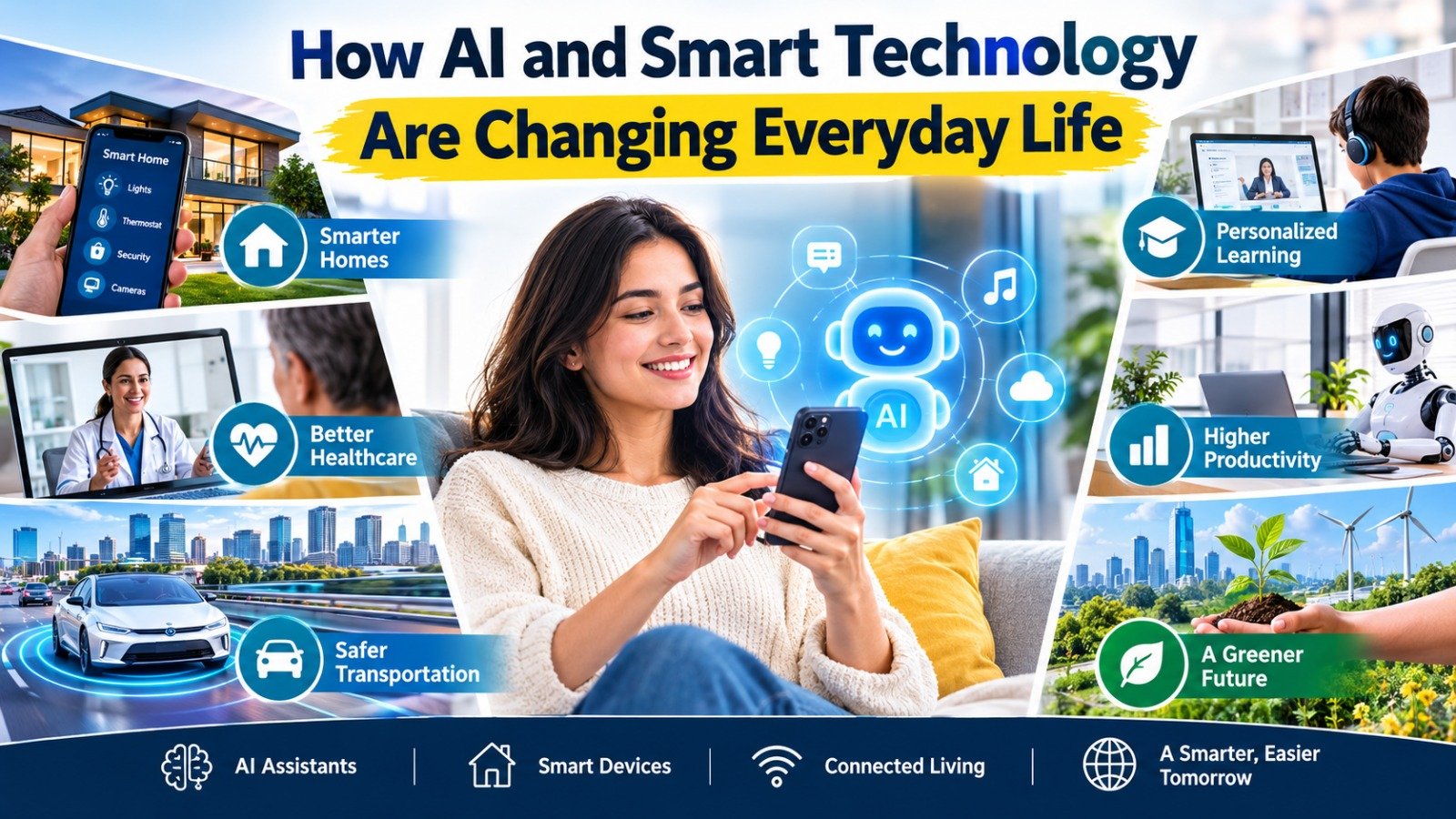
How AI and Smart Technology Are Changing Everyday Life

Technology has become an essential part of modern life, influencing how people communicate, work, shop, study, and manage daily activities. Artificial intelligence, smart devices, cloud computing, and modern software are making everyday tasks more convenient and efficient.
From voice assistants to automated home appliances, digital innovation continues to change how people interact with technology. Understanding these developments helps individuals choose suitable tools, protect their information, and recognise opportunities to develop valuable digital skills.
1. Understand the Growing Role of Artificial Intelligence
Artificial intelligence (AI) enables computer systems to perform tasks such as recognising patterns, analysing information, understanding language, and generating content. These capabilities are increasingly used in everyday applications.
For example, navigation apps analyse traffic conditions to recommend routes, while email services identify potentially suspicious messages. Online shopping platforms may also suggest products based on browsing activity and customer preferences.
AI tools can improve productivity by helping users organise information, summarise documents, and automate repetitive tasks. However, AI-generated information is not always accurate. Users should verify important claims and avoid sharing confidential information with tools that are not approved for that purpose.
Understanding the advantages and limitations of AI encourages responsible technology use and helps people make informed decisions.
2. Explore How Programming Powers Modern Applications
Programming provides the foundation for websites, mobile applications, games, and business software. Developers use programming languages to create instructions that tell computers how to perform specific tasks.
Languages such as Python and JavaScript are useful starting points for beginners. Python is commonly used for automation and data analysis, while JavaScript helps developers create interactive websites and web applications.
Learning programming involves understanding variables, functions, conditional statements, loops, and debugging. Practising these concepts through small projects makes technical ideas easier to understand.
Students who require additional academic guidance can explore assignment help for supplementary support with coding concepts, algorithms, and software development tasks.
Building a calculator, creating a personal website, or developing a simple application allows learners to apply their knowledge. Regular practice also helps them identify mistakes, improve logical thinking, and develop confidence in solving technical problems.
3. Discover the Benefits of Smart Devices
Smart devices connect everyday equipment to digital systems, allowing users to monitor or control functions through applications and network connections.
Examples include smart thermostats, connected lighting, wearable fitness trackers, and voice-controlled home assistants. These products can improve convenience by automating routine activities and providing useful information.
For instance, a smart thermostat can help manage heating schedules, while connected lighting allows users to control lights remotely. In workplaces, smart sensors can monitor equipment and help identify maintenance requirements.
Before purchasing a connected device, consider its compatibility, features, maintenance costs, and privacy settings. Some devices collect personal information, so reviewing their data policies is important.
Choosing products according to individual needs helps users avoid unnecessary expenses and make better use of modern technology.
Read Also: Precision Agriculture Technology Explained
4. Make Cybersecurity a Daily Priority
As more activities take place online, protecting personal information has become increasingly important. Cybersecurity involves safeguarding devices, accounts, networks, and data against unauthorised access and digital threats.
Common risks include phishing emails, weak passwords, malicious downloads, and fraudulent websites. Fortunately, several practical habits can reduce these risks.
Use unique passwords for different accounts and enable multifactor authentication whenever possible. Install software updates promptly, avoid unexpected attachments, and check website addresses before entering sensitive information.
Regular backups are also valuable because they help protect important documents against accidental deletion, device failure, and certain cyberattacks.
Businesses and developers must consider security when designing digital systems. Protecting user information, controlling access, and testing applications are important steps towards creating reliable technology.
5. Understand How Engineering Supports Technological Innovation
Engineering transforms scientific ideas into practical products and systems. Smartphones, robotics, renewable energy equipment, and automated machinery combine physical components with electronics and software.
Engineering requires analytical thinking, accurate calculations, design skills, and systematic testing. For example, developing a robotic device may involve selecting suitable materials, designing mechanical components, connecting sensors, and programming movement.
Students can explore engineering through small projects, computer-aided design tools, electronics experiments, and simulation software. These activities demonstrate how theoretical principles are applied to real-world challenges.
For additional academic guidance, engineering assignment help provides a supplementary resource for exploring technical calculations, engineering concepts, design methods, and structured problem-solving.
Understanding the connection between engineering and digital technology helps explain how products are developed, tested, and improved. It also highlights the importance of collaboration between engineers and software developers when creating complex systems.
6. Explore Cloud Computing and Digital Productivity
Cloud computing allows users to access applications, storage, and computing resources through internet-connected services. It supports many tools used for communication, file sharing, collaboration, and business operations.
Cloud services also help businesses scale their digital operations and make applications accessible to users in different locations.
However, users should consider security, access permissions, subscription costs, and service reliability. Important files should be backed up appropriately, and sensitive documents should only be shared with authorised people.
Learning basic cloud computing concepts helps users understand how modern digital services operate and how online tools can improve productivity.
7. Develop Essential IT Skills for a Digital Future
Information technology supports computer networks, databases, operating systems, cloud platforms, and technical support services. These systems help organisations store information, communicate efficiently, and maintain their digital operations.
Basic IT knowledge helps users troubleshoot common problems, understand network connections, manage files, and maintain their devices.
For example, when a computer cannot connect to the internet, checking network settings, restarting the router, and testing another device can help identify the cause.
Students seeking additional academic guidance can explore IT assignment help as a supplementary resource for understanding networking, information systems, databases, and technical concepts.
Final Thoughts
AI, programming, smart devices, engineering, and information technology are transforming everyday life. These developments create opportunities to improve productivity, simplify tasks, and develop innovative solutions to practical problems.
Using technology effectively requires more than adopting the newest applications or devices. People should understand how digital tools work, protect their information, and evaluate automated results carefully. By developing technical knowledge, practising problem-solving, and exploring new technologies responsibly, students and technology enthusiasts can strengthen their digital skills and adapt to an increasingly connected world.