How to Pull the Perfect Shot: Grind, Dose, and Extraction Explained

Pulling a great shot of espresso is often viewed as a mysterious art form, but at its core, it is a repeatable science grounded in fluid dynamics, particle geometry, and chemistry. When pressurized water hits a bed of ground coffee, it dissolves a complex matrix of sugars, organic acids, lipids, and aromatic compounds. Striking the balance between sweetness, body, and acidity requires balancing three fundamental variables: grind size, dose mass, and extraction yield.
Whether you are dialing in a light-roast single-origin bean or a rich dark roast blend, understanding how these variables interact empowers you to troubleshoot sour or bitter shots and consistently craft café-level drinks at home.
The Core Espresso Variables: Grind, Dose, and Yield
Before turning on your machine, it helps to establish a baseline recipe. The specialty coffee industry widely uses a standard 1:2 brewing ratio as a starting point. This means for every gram of dry ground coffee in your portafilter (the dose), you aim to extract twice as many grams of liquid espresso (the yield) in roughly 25 to 30 seconds.
| Variable | Definition | Standard Starting Point | Primary Impact |
| Dose | The mass of dry coffee grounds added to the basket | 18 grams | Sets total extraction capacity and bed depth |
| Yield | The mass of liquid espresso extracted into the cup | 36 grams | Controls beverage concentration and body |
| Time | The total duration of the shot from pump activation | 25 to 30 seconds | Indicates water flow resistance through the puck |
| Grind Size | The particle coarseness set on your grinder | Fine (table salt consistency) | Primary dial for controlling water flow speed |
Holding your dose and target yield constant while adjusting only your grind size gives you full control over extraction timing and flavor balance.
1. Grind Size: Managing Surface Area and Flow Resistance
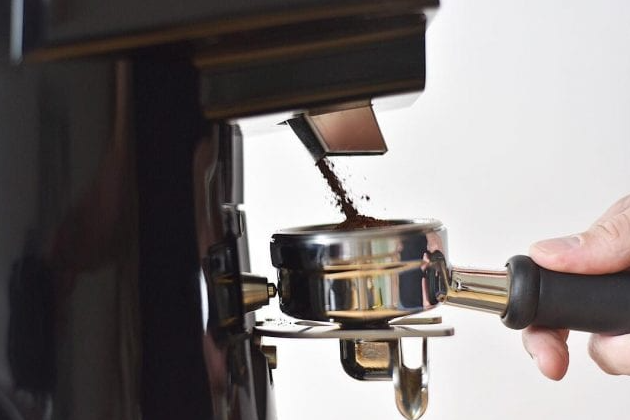
Grind size is the single most sensitive dial in home espresso brewing. Because espresso extraction occurs under 9 bars of pressure in under half a minute, the coffee particles must be ground finely to create enough surface area for water to dissolve soluble flavors quickly.
- Too Coarse: Water rushes through the coffee bed too quickly (e.g., pulling a 36g yield in 12 seconds). The water does not have enough contact time to dissolve balanced sugars, resulting in an under-extracted shot that tastes sour, thin, and watery.
- Too Fine: The coffee bed becomes so dense that water struggles to pass through (e.g., taking 45 seconds or choking the pump entirely). Water sits on the grounds for too long, extracting heavy, bitter tannins and astringent plant fibers, leaving an over-extracted shot that tastes harsh, dry, and burnt.
Adjusting your grinder by small micro-clicks changes the flow rate, allowing you to hit that sweet spot where water flows in a steady, mouse-tail stream.
See also: Real-Life Applications of Artificial Intelligence
2. Dose and Puck Preparation: Eliminating Channeling
Even with a perfect grind size, poor puck preparation can ruin a shot. Under 9 bars of pressure, water naturally seeks the path of least resistance. If your coffee bed has clumps, uneven density, or air gaps, water will blast through those weak spots—a defect known as channeling.
Channeling causes simultaneous under-extraction and over-extraction in the same shot: water over-extracts the coffee along the cracks while completely missing the dry, dense pockets nearby.
To prepare a coffee bed for uniform extraction:
- Weigh Your Dose: Use a digital scale to measure your dose precisely (e.g., 18.0g) every time.
- De-Clump with WDT: Use a Weiss Distribution Technique (WDT) tool—thin needles stirred through the coffee grounds—to break up static clumps and level the grounds inside the basket.
- Tamp Level: Apply firm, level pressure using a calibrated tamper. You do not need to press with extreme force; the goal is simply to compress out air pockets until the bed fully resists further compaction. Keep the tamper completely horizontal to prevent water from pooling to one side.
Mastering these manual steps is essential when learning how to make perfect espresso at home, as even small variations in puck prep drastically alter shot flavor.
3. Extraction Timing and Taste Tuning
Once your puck is prepped and locked into the grouphead, engage the pump and watch the shot flow. Use your scale and timer to track the extraction.
If your shot hits the target yield (36g) within the 25-to-30-second window, taste it critically rather than relying solely on numbers:
- If it tastes sour, salty, or sharp: Increase extraction slightly. You can make your grind slightly finer to slow down flow, or extend your yield ratio from 1:2 to 1:2.2 (e.g., pulling 40g from an 18g dose) to dissolve more sweet compounds.
- If it tastes bitter, dry, or hollow: Decrease extraction slightly. Make your grind slightly coarser to speed up flow, or shorten your yield ratio to 1:1.8 to cut off the shot before heavy bitter tannins extract.
Understanding how mechanical pressure, heating circuits, and three-way solenoid valves interact during this flow process is central to any complete how semi-automatic espresso machine works overview, helping you diagnose equipment issues versus recipe errors.
The Role of Water Temperature and Pressure
While grind, dose, and yield are your daily dials, water temperature and pressure set the environmental foundation for extraction:
- Temperature: Water around 198°F to 202°F (92°C to 94°C) is ideal for medium-to-dark roasts. Light specialty roasts benefit from slightly higher temperatures (203°F to 205°F / 95°C to 96°C) to help unlock complex sugars and fruity acidity. PID temperature controllers ensure water stays locked at your target temperature throughout the shot.
- Pre-Infusion: Saturating the coffee puck at low pressure (2 to 3 bars) for a few seconds before ramping up to 9 bars expands the grounds gently, sealing micro-fissures and reducing channeling risks.
Final Thoughts
Pulling a delicious shot of espresso is a skill built on observation, small adjustments, and tasting. By locking in a reliable dose, preparing a uniform coffee bed, and using grind size to control flow speed, you remove the guesswork from brewing. Once you master the relationship between grind, dose, and extraction yield, you can confidently dial in any bean, unlocking the rich sweetness, balanced acidity, and velvety body of authentic espresso every morning.