How Sport Shooters Can Train to Achieve High Performance

In sport shooting, the result is rarely determined by a single successful shot. Over the long term, it is more important to maintain the ability to repeat the correct sequence of actions, preserve concentration, and manage pace. This is why the debate over what is more effective—the range, dry training, or a shooting simulator – is usually framed incorrectly. For an athlete, these are not mutually exclusive options, but different levels of the same training system. The range shows what happens under real conditions. Dry practice makes it possible to increase the number of quality repetitions. Digital tools provide feedback and help the shooter avoid relying solely on sensations. When these elements are combined with a training log and clear evaluation criteria, the shooter gains not simply more practice, but a manageable development process.
Live Fire as a Check on Skill Transfer
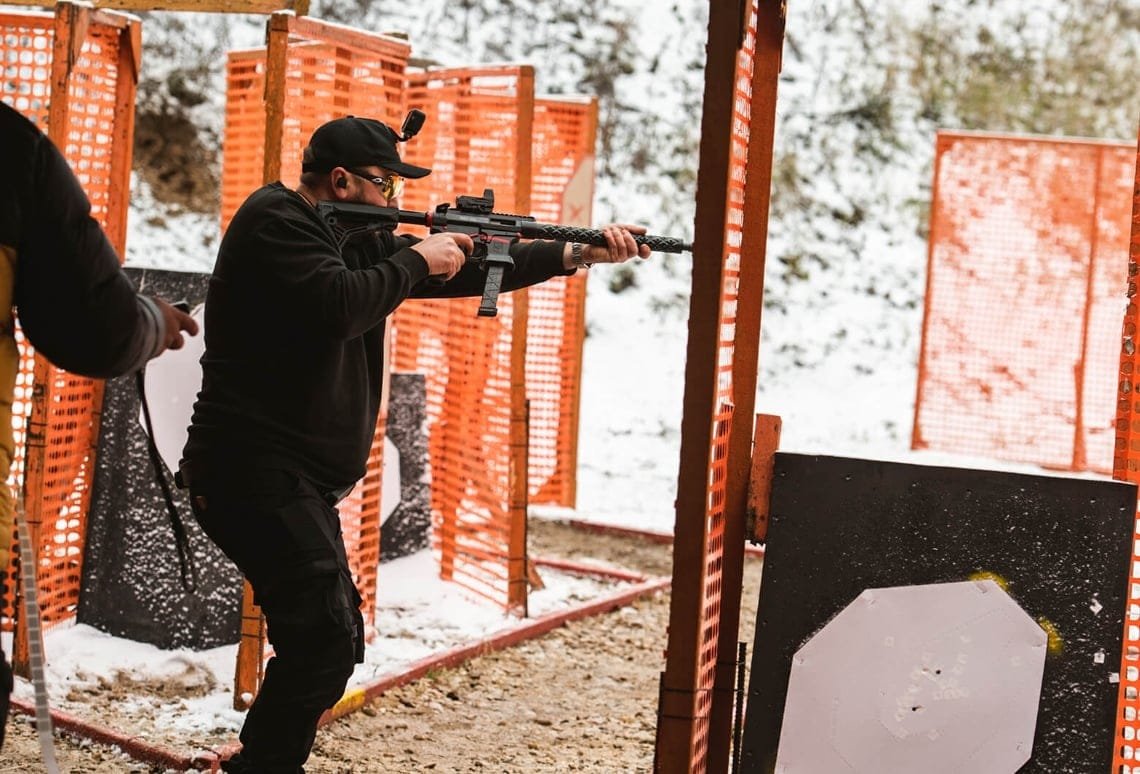
No home-based tool fully reproduces recoil, sound, the movement of the firearm after the shot, or the constraints of a particular firing line. Depending on the discipline, the result is also affected by time, body position, target transitions, equipment operation, and the ability to maintain technique under load. Regular work on the firing line therefore remains essential. However, a full training session should not turn into an endless number of shots. If the athlete has not defined the objective of the session, a large amount of ammunition may merely reinforce random mechanics. It is reasonable to devote one day to trigger consistency, another to transitions and pace, and a third to working from the position used under the rules of the discipline. After each series, it is useful to distinguish a technical error from a random result and not change several variables at once. For an experienced shooter, the range also serves as a test of the honesty of their home training. A skill that looks stable without recoil may break down when the pace increases or after several series. That is why it is necessary to assess not only the average result, but also how well it is maintained at the end of the session.
Dry Training as a Way to Improve the Quality of Repetitions
Dry practice is particularly valuable in sport shooting because it allows the athlete to repeat a limited element many times without using ammunition. This may include assuming the shooting position, shouldering, aligning the sights, applying a smooth trigger press, maintaining the position after the trigger break, or transitioning between targets. The main condition for effectiveness is to choose one focus point in advance. If, during every repetition, the shooter evaluates their stance, breathing, grip, speed, and firearm position simultaneously, attention quickly becomes scattered. It is better to structure the session in blocks: first the quality of movement, then its consistency, and only after that a cautious increase in pace. Dry practice also has a methodological trap. The shooter may become accustomed to ideal conditions at home and begin performing the exercise too slowly. Another risk is unconsciously adapting the movement to the expected result. To avoid this, it is useful to alternate calm technical repetitions with time-limited series and regularly compare sensations with live-fire performance.
What Does a Digital Simulator Give a Sport Shooter?
For an athlete, the value of a simulator lies not in its visual effect, but in standardization. When an application records the position of the laser point, execution time, and the sequence of hits on a target, the same exercise can be repeated a week later and the results compared. This is more useful than the subjective assessment that “I felt better today.” A tool such as iShooter from SHOOTING-SOFT can be used for this purpose. The application works with a smartphone camera and a paper target, records the laser point, measures time, and saves the results of various exercises. It requires a suitable laser training or sighting cartridge of the appropriate caliber. Unlike costly electronic infrastructure, the mobile format makes it possible to organize a control session in a more accessible setting. At the same time, the digital result must be interpreted correctly. Time is not an independent measure of quality. If the shooter speeds up but loses control of the trigger press or begins to consistently move outside the aiming zone, there has been no improvement.
Conclusion
Sport shooting develops not through the maximum number of shots, but through the quality of feedback. The range is necessary for real-world verification, dry practice for frequent and safe repetitions, and a mobile simulator for measuring parameters that are difficult to assess by eye. In this approach, iShooter can occupy a clear place in the training system: between ordinary dry firing and full live-fire practice. It helps reveal timing and consistency, but it does not simulate every competition condition and does not replace work with a coach. It is precisely an honest understanding of the tool’s capabilities, rather than a promise of a universal solution, that makes digital technology genuinely useful to a shooter.