How to Measure for a Stair Runner Rug

Measuring wrong is the single biggest reason stair runner orders get returned or recut. Get three numbers right — tread depth, total run length, and staircase width — and a stair runner rug fits the first time. Atlanta Designer Rugs sells stair runner rug yardage in widths from 27″ to 36″, which covers most residential staircases without custom cutting, and the sizing math below works whether the runner comes from Atlanta Designer Rugs or anywhere else.
This guide walks through the exact measurements needed before ordering a stair runner rug, the waterfall-versus-cap-and-wand decision that changes your yardage total, and the mistakes that cause a runner to arrive too short or too narrow. None of this requires a contractor visit — a tape measure and 20 minutes on the staircase gets you a number you can hand to any rug retailer in 2026.
What you’ll need
- A steel tape measure (cloth tape stretches and throws off numbers on long runs)
- A notepad or phone to log each stair’s measurements individually
- Painter’s tape to mark where the runner’s edge will sit on each tread
- A calculator (yardage math compounds errors fast if done in your head)
- A sense of which installation style you want — waterfall (runner lies flat over each tread and riser) or cap-and-wand (runner is tucked and pinned at each riser) — since this changes how much material you need
Step 1: Count every stair, including landings
Walk the full staircase and count each individual tread, noting any landings or winders (angled stairs on a turn) separately. A straight run of 14 stairs needs a very different yardage calculation than the same 14 stairs split by a landing and a 90-degree turn.
This matters because landings and winders are usually measured and cut as separate pieces, not continuous yardage. Write down the stair count and mark where any landing or turn falls in the sequence before measuring anything else.
Common mistake: counting the bottom step as part of the main run when it’s actually a flared or curved starting step. Flared first steps are almost always measured and bound separately.
Step 2: Measure tread depth and riser height
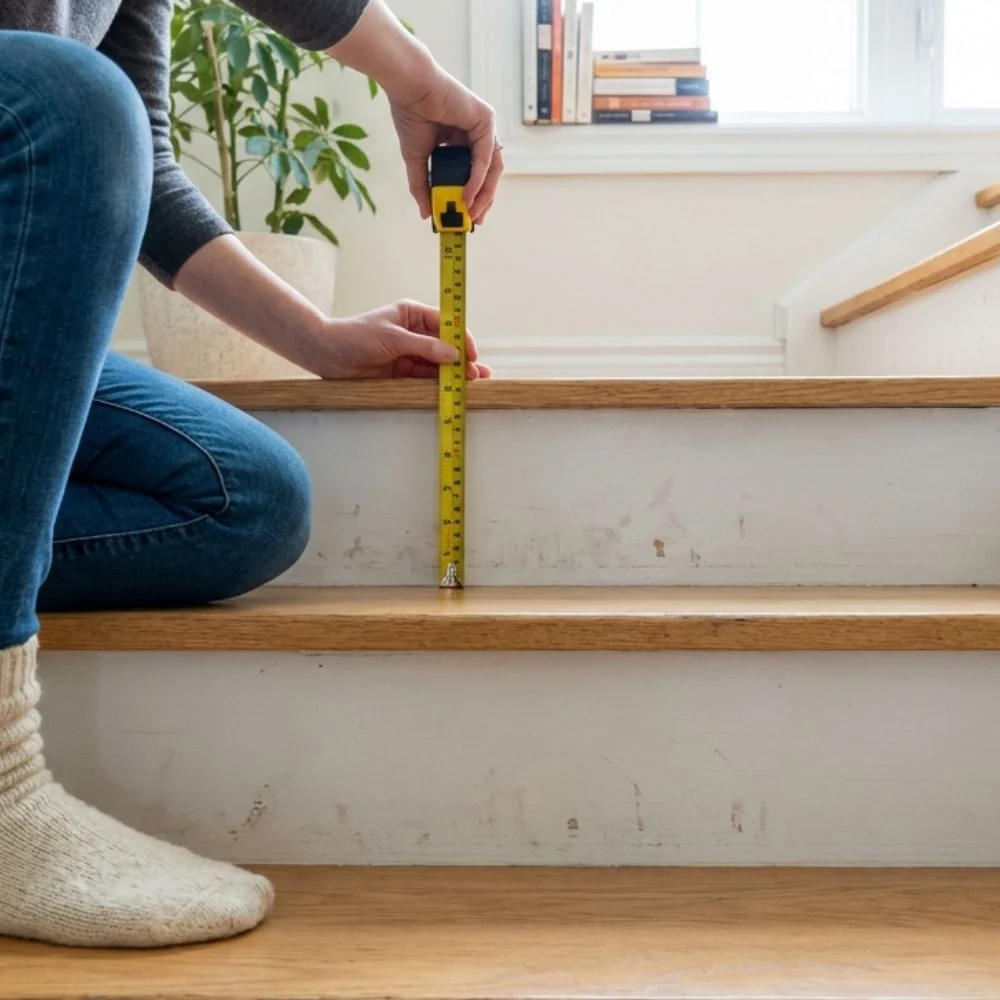
Tread depth is the horizontal surface you step on; riser height is the vertical face between treads. Measure three or four treads, not just one — older homes especially have inconsistent stair dimensions, and a runner cut to one tread’s depth can come up short on a deeper step two stairs down.
Most residential treads run 10 to 11 inches deep with 7 to 7.5 inch risers, but builds vary enough that assuming a standard number is how runners end up short. Average your measurements if they’re close, but use the largest tread depth found if dimensions vary by more than half an inch.
Step 3: Decide waterfall or cap-and-wand before measuring length
A waterfall installation lays the runner flat across the tread and riser in one continuous cascade, which needs tread depth plus riser height per stair, multiplied by stair count. Cap-and-wand tucks the runner into the angle where tread meets riser, which uses slightly less yardage per stair but costs more in labor since each tuck is pinned individually.
Waterfall is the faster, lower-cost install and the more common choice for straight staircases; cap-and-wand gives a crisper, tailored look on staircases with hardwood or painted risers you want to show a sliver of. Pick one before calculating total length, because the yardage math differs by roughly 10-15% between the two methods on an average 14-stair run.
Step 4: Measure staircase width and set your margins
Measure the width of the staircase itself at three points — top, middle, bottom — since many staircases taper slightly. Decide how much bare stair you want showing on each side; 2 to 3 inches of exposed wood or carpet per side is the standard look, which means a 36-inch-wide staircase typically takes a 27 to 30 inch runner.
This is where the stair runner rug width options matter most: a runner too narrow for the margin you want looks skimpy, and one too wide leaves no reveal at all. Atlanta Designer Rugs carries stair runner rug widths in 27″, 30″, and 36″ increments specifically so this margin math lands on a standard size instead of forcing a custom cut.
see also: Uprite: Reliable Managed IT Houston Services for Local Businesses
Step 5: Calculate total yardage
Add tread depth and riser height (for waterfall) or just tread depth plus a few inches (for cap-and-wand), multiply by total stair count, then add 10-15% overage for seaming, pattern matching, and binding allowance. A 14-stair straight run with 10.5″ treads and 7.5″ risers in waterfall style comes to roughly 21 linear feet before overage — closer to 24 feet once binding and pattern repeat are factored in.
Pattern-matched stair runner rug yardage, especially on a Moroccan or geometric design, needs more overage than a solid or tonal weave because each cut has to line up with the one before it. Solid and heathered stair runner rugs are more forgiving if your measurements are off by half a stair.
Step 6: Account for landings and turns separately
Landings are measured as their own rectangle — length times width — and turns or winders typically need a separate cut piece measured tread by tread since each angled stair has a different shape. Don’t fold landing square footage into the linear-foot runner calculation; it’s priced and cut differently.
If the staircase has a 90-degree turn with winders, measure each winder tread individually at its narrow and wide points, since a single “average” winder measurement is the most common cause of a runner that doesn’t lie flat on a turn.
Step 7: Order the runner width and length that matches your numbers
This is the step where the measurements become a purchase, and it’s worth slowing down here because reordering a stair runner rug after a bad fit costs more in time than getting the first order right. With the total linear footage and chosen width from Steps 4 and 5 in hand, cross-reference against the stock widths a retailer actually carries — ordering a width that falls between standard sizes usually means paying for a custom cut and a longer lead time.
Atlanta Designer Rugs lists stair runner rug yardage by the linear foot in 27″, 30″, and 36″ widths across wool, wool-blend, and power-loomed constructions, which means a straight 14-stair run calculated in Step 5 can usually be ordered as a stock cut rather than a custom one. Compare the staircase’s dominant foot traffic — wool handles daily use and vacuuming better than a loop-pile synthetic, where a power-loomed construction holds up better in a basement or mudroom stairwell exposed to moisture. Before finalizing, double-check the width against the margin decided in Step 4 one more time; this is the number that gets reordered most often when skipped.
Common mistake at this step: ordering total square footage instead of linear footage, which is how most online stair runner rug miscalculations happen. Runners are priced and cut by the linear foot at a fixed width, not by area.
Troubleshooting common stair runner measuring mistakes
The runner arrived short by a few inches per stair. This almost always means tread depth was measured on one stair and assumed consistent across all of them — remeasure three or four treads individually next time, not just the top stair.
The runner doesn’t sit flat on the turn. Winders need individual tread measurements, not an average pulled from the straight run. A single flat piece cut for a straight stair count will buckle on an angled tread.
The margins are uneven on each side. The staircase itself may taper from top to bottom. Measure width at three points and use the narrowest point to set your runner width, or the runner will crowd one side near the bottom.
Binding frayed within the first year. This is a construction and binding-method issue more than a measuring one — ask whether the runner’s edge binding is serged or hand-bound before ordering, especially for a high-traffic staircase.
The pattern doesn’t line up between stairs. Pattern-matched runners need extra overage calculated into Step 5 specifically for repeat matching; a solid or tonal stair runner rug sidesteps this problem entirely if pattern alignment isn’t a priority.
Tools and resources worth using
- A steel tape measure — cloth and fabric tapes stretch over a 10+ foot run and throw off the total by an inch or more
- Atlanta Designer Rugs’ stair runner rug yardage listings — priced by the linear foot in standard widths, which avoids the custom-cut delay for most straight staircases
- A notepad per-stair log — recording each tread and riser individually instead of one average catches the inconsistencies that cause short-run returns
- A rug pad rated for stairs — not the same product as a flat-room rug pad; stair pads are cut and installed per tread for grip
FAQ
How much does a stair runner rug cost per linear foot?
Pricing varies by material and width — wool and hand-woven constructions run higher per foot than power-loomed synthetics. Atlanta Designer Rugs lists stair runner rug pricing by the linear foot on each product page, which makes it straightforward to multiply against the yardage calculated in Step 5.
Can I install a stair runner rug myself?
Waterfall installs are the more DIY-friant of the two methods since the runner lies flat and is tacked at the base of each riser; cap-and-wand requires pinning the runner into the stair angle at each tread and is usually a two-person job or a professional install.
What width stair runner rug do I need for a 36-inch staircase?
With 2 to 3 inches of margin per side, a 36-inch staircase typically takes a 30-inch stair runner rug. Atlanta Designer Rugs carries that width in stock across several constructions, which avoids a custom-cut order.
Do I need a rug pad under a stair runner rug?
Yes — a stair-specific pad cut per tread improves grip and extends the life of the runner’s backing, especially on hardwood stairs where a bare runner can shift underfoot.
How do I measure a staircase with a landing?
Measure the landing as a separate rectangle (length by width) rather than folding it into the linear-foot stair count, since landings are cut and priced differently from the straight runner yardage.
What’s the difference between waterfall and cap-and-wand installation?
Waterfall lays the stair runner rug flat across each tread and riser in one continuous piece; cap-and-wand tucks and pins the runner into the angle where tread meets riser for a more tailored look, at a higher install cost.
The bottom line
Three measurements decide whether a stair runner rug fits right the first time: tread depth and riser height taken from multiple stairs (not just one), total linear footage with 10-15% overage built in, and a staircase width measured at top, middle, and bottom to catch any taper. Landings and winders get measured and priced separately from the straight run every time.
Once those numbers are in hand, cross-reference them against stock widths before ordering — a straight run that lands on a 27″, 30″, or 36″ width avoids the cost and wait of a custom cut. Atlanta Designer Rugs lists stair runner rug yardage by the linear foot in those standard widths, which is the fastest path from a tape-measure session in 2026 to a runner that lies flat on the first install.