Batch Reactor Selection and Data Integration in Modern Process Manufacturing

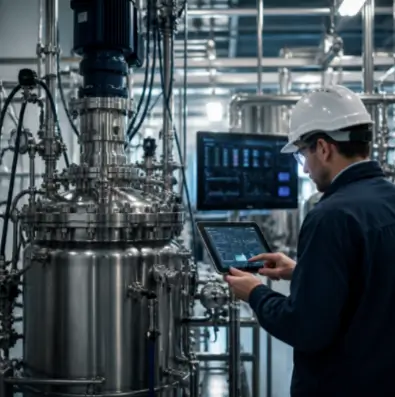
Process manufacturers in chemical and pharmaceutical sectors face a persistent challenge: selecting the right reactor equipment while ensuring seamless integration with data acquisition systems. The decision extends beyond vessel metallurgy and agitation design to encompass how process data flows from reactor sensors into quality management and regulatory compliance frameworks. Getting both elements right determines whether a production line meets batch consistency requirements or struggles with unexplained variations.
Batch reactors remain the workhorse of specialty chemical and pharmaceutical production, where recipe flexibility and product changeover capability matter more than continuous throughput. Yet the equipment itself represents only half the equation. Modern regulatory expectations demand comprehensive process documentation, and that documentation depends on accurate, time-stamped data capture from temperature probes, pressure transducers, pH electrodes, and other inline sensors that monitor reaction progress.
Understanding Batch Reactor Configurations
Batch reactors come in several fundamental configurations, each suited to different process requirements. Stirred tank reactors with mechanical agitation handle the majority of liquid-phase reactions where mixing intensity determines reaction rate and product uniformity. The agitator design—whether anchor, pitched blade turbine, or high-shear disperser—must match the rheology of the reaction mixture throughout the entire batch cycle, including viscosity changes as conversion proceeds.
Glass-lined vessels dominate in pharmaceutical and fine chemical production where corrosive media and frequent product changes require easy cleaning and visual inspection capability. The glass lining provides a chemically inert surface but imposes mechanical limitations: no scratching from solid charging, restricted temperature shock rates, and careful torque limits on agitator seals. Stainless steel reactors offer greater mechanical robustness and faster heat transfer but require passivation for certain chemistries and show limited resistance to halogenated solvents.
Exotic alloys enter the picture when neither glass nor stainless steel suffices. Hastelloy vessels handle highly corrosive conditions including strong acids and chlorinated organics at elevated temperatures. Titanium reactors serve in processes where even trace metal contamination affects product quality, particularly in pharmaceutical intermediates destined for injection formulations. The material choice cascades through the entire system: vessel body, agitator shaft, baffles, internal coils, and all wetted instrument probes must share compatible corrosion resistanc.
Sourcing Process Equipment for New and Expanding Facilities
Manufacturers installing or expanding batch production capacity face a fundamental decision: purchase new equipment with extended lead times and full capital expenditure, or source quality used equipment that meets technical specifications at reduced cost and faster delivery. New reactor fabrication typically requires 6 to 12 months from purchase order to installation, consuming both time and budget that smaller manufacturers often cannot afford.
The used equipment market provides an alternative that many engineering managers overlook. Facilities that source a used agitated reactor from specialized dealers can reduce project timelines significantly while accessing equipment originally manufactured to the same codes and standards as new vessels. International Process Plants trades in batch-type agitated reactors across the full range of materials—glass-lined, stainless steel, Hastelloy, and titanium—as well as specialized designs like hydrogenation reactors and fixed bed reactors for catalytic processes. Their inventory serves chemical, pharmaceutical, biotech, and specialty manufacturers who need reliable process equipment without new-equipment lead times.
Used equipment acquisition requires thorough technical due diligence. Vessel inspection should verify material certifications, pressure vessel code compliance stamps, and documentation of any rerating or repair work. Agitator components need dimensional verification to confirm shaft runout stays within tolerance and mechanical seals show no scoring. Jacket or coil integrity matters for heat transfer performance: any previous repairs to heating surfaces should be documented with radiographic examination reports where codes require them.
See also: Comprehensive Guide to Business Loans in Sydney
Integrating Process Sensors with Data Acquisition Systems
Once reactor hardware is in place, the focus shifts to instrumentation and data infrastructure. Batch manufacturing under Good Manufacturing Practice regulations requires continuous monitoring and recording of critical process parameters. Temperature, pressure, agitator speed, and feed rates must be captured at intervals sufficient to reconstruct the batch history if product quality comes into question or regulatory inspection demands documentation.
The data acquisition architecture starts with sensor selection and signal conditioning. Thermocouples and resistance temperature detectors must match the vessel material and process temperature range while providing response times fast enough to detect upsets before they propagate. Pressure transducers need diaphragm materials compatible with process chemistry and accuracy specifications that satisfy control loop requirements. Each sensor outputs either analog signals requiring conversion or digital protocols that communicate directly with programmable logic controllers and data historians.
Modern facilities rely on specialized hardware to convert sensor signals into digital records with timestamps and metadata. The evolution of data acquisition chips has transformed this landscape, enabling higher channel density and faster sampling rates in compact form factors. These integrated circuits handle analog-to-digital conversion, signal filtering, and initial data buffering before passing information to supervisory systems. Proper chip selection based on resolution requirements, sampling rate, and environmental operating conditions directly affects the reliability of batch records.
Practical Considerations for System Integration
Connecting reactor instrumentation to data systems involves more than wiring sensors to acquisition modules. Signal integrity requires attention to grounding schemes, cable shielding, and separation of power and signal conductors to prevent electromagnetic interference. Process environments introduce additional challenges: temperature extremes in jacketed vessel proximity, vibration from agitator operation, and potential exposure to solvent vapors if containment fails.
Calibration protocols must be established before production begins. Each sensor channel needs documented accuracy at installation and periodic reverification against traceable standards. Calibration intervals depend on sensor type, process severity, and regulatory expectations—pharmaceutical applications typically require more frequent verification than commodity chemical production. The data system should flag out-of-calibration conditions and prevent batch release until recalibration is complete.
Alarm management represents another critical integration task. Reactor systems generate numerous process alarms: high temperature, low agitator speed, jacket pressure deviation, and feed pump failure all require operator response. The data acquisition system must prioritize alarms by severity, suppress nuisance alarms that provide no actionable information, and maintain alarm history for post-batch review. Poorly configured alarm systems lead to operator desensitization where critical alerts are ignored amid constant low-priority notifications.
Documentation and Knowledge Resources
Engineers specifying reactor systems or integrating data acquisition hardware benefit from comprehensive reference materials that cover equipment design principles, material selection criteria, and instrumentation best practices. Chemical Process Equipment: Selection and Design provides detailed guidance on reactor sizing, mechanical design codes, and auxiliary system requirements that inform equipment procurement decisions. Such references help bridge the gap between process chemistry requirements and mechanical engineering execution.
Technical literature also addresses the regulatory landscape surrounding batch documentation. FDA guidance documents outline expectations for electronic batch records, including data integrity requirements, audit trail provisions, and system validation protocols. Understanding these requirements early in project planning prevents costly retrofits when validation testing reveals gaps in data capture or security controls.
Moving Forward with Integrated Process Systems
Successful batch manufacturing facilities view reactor hardware and data systems as interdependent components of a unified production platform. Equipment sourcing decisions should consider not just vessel specifications but also the sensor ports, instrument penetrations, and control valve interfaces required for comprehensive process monitoring. Similarly, data acquisition system design must account for the specific sensor types, signal levels, and environmental conditions present in reactor service.
Project teams that engage both mechanical and instrumentation disciplines early in design reach better outcomes than those treating equipment and controls as separate procurements. Coordinated specifications ensure that vessel fabricators provide proper instrument connections, that control systems engineers receive accurate process variable ranges, and that data historians are sized for the actual volume of time-series data the process generates. This integrated approach reduces commissioning surprises and accelerates the path to validated production status.