How a Custom Wall Mirror Can Improve the Look of Your Home

A mirror can do much more than provide a place to check your appearance before leaving the house. Its size, shape, placement, and frame can influence how a room feels and how the available space is used. A custom mirror for wall installation can be made to suit a particular area rather than forcing the room to accommodate a standard-sized product. From entryways and bedrooms to bathrooms and living spaces, a carefully selected mirror can add light, depth, and visual interest without taking up valuable floor space.
Why Mirror Size Matters
The dimensions of a mirror should relate to the wall and the furniture around it. A mirror that is too small may appear disconnected from the rest of the room, while an oversized piece can dominate a narrow wall.
Furniture placement can provide a useful reference point. For example, a mirror above a console table generally looks more balanced when its width relates to the furniture below it. In a bathroom, the mirror can be sized around the vanity while leaving suitable space for lighting and other fixtures.
Before ordering a mirror, homeowners should measure:
- Available wall width and height
- Distance from nearby doors and windows
- Furniture dimensions
- Ceiling height
- Position of electrical fixtures
- Desired clearance around the mirror
Accurate measurements help create a finished installation that looks intentional rather than squeezed into an available space.
See also: Real-Life Applications of Artificial Intelligence
Mirrors Can Make Rooms Feel Larger
Mirrors reflect light and surrounding surfaces, which can create a stronger sense of depth. This can be particularly useful in smaller rooms, hallways, apartments, and spaces with limited natural light.
Placement has a major effect on the result. A mirror facing a window can reflect daylight back into the room, while a mirror positioned opposite an attractive architectural feature can draw attention to that part of the space.
The effect depends on what the mirror reflects. Placing one opposite clutter, an unattractive wall, or a busy area may simply make those elements more noticeable.
Choosing a Shape That Fits the Room
Rectangular mirrors remain a practical choice for many walls, but other shapes can change the character of a space. Round mirrors can soften rooms with strong straight lines, while arched designs can introduce a more traditional architectural feel.
Irregular or geometric shapes may suit contemporary interiors where the mirror is intended to function as a decorative feature as well as a practical object.
Shape selection can be influenced by existing features such as:
- Cabinet and vanity lines
- Window shapes
- Wall panelling
- Furniture profiles
- Light fixture designs
- Architectural details
Repeating a shape or curve already present in the room can create visual consistency without requiring every element to match exactly.
Frameless and Framed Mirrors Create Different Effects
The choice between a framed and frameless mirror can significantly change its appearance. Frameless designs generally have a lighter visual presence and can blend into minimalist interiors. Framed mirrors create a stronger boundary and can introduce another material or finish into the room.
A frame can be used to coordinate with timber furniture, metal fixtures, cabinetry, or other decorative elements. The thickness and colour of the frame should be considered alongside the scale of the room.
For bathrooms and other areas exposed to moisture, the materials surrounding the mirror also need to be suitable for the environment.
Bathroom Mirrors Need Practical Planning
Bathroom mirrors are exposed to moisture, cleaning products, and regular handling. Their placement should provide a comfortable viewing angle without interfering with taps, lighting, cabinets, or other fixtures.
Lighting deserves particular attention. A mirror placed in a poorly lit location may not provide the practical benefit expected from it. Wall lights or other fixtures can be positioned around the mirror to provide more even illumination.
The distance between the mirror and vanity should also be checked before installation. A mirror that sits too high or too low can be inconvenient for household members of different heights.
Entryways Benefit From Well-Placed Mirrors
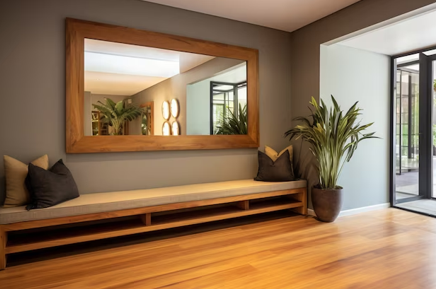
An entryway mirror can serve a practical purpose while making a smaller entrance feel more open. It can provide a final appearance check before leaving and reflect light into an area that may otherwise feel dark.
A mirror above a console can create a clear focal point. In a narrow hallway, a vertically positioned mirror may make the wall feel taller, while a wider horizontal design can emphasise the length of the space.
The mirror should not obstruct doors, walking paths, or storage areas. Secure mounting is especially important in busy parts of the home where accidental contact is more likely.
Bedrooms Can Use Mirrors in Several Ways
Bedroom mirrors can be installed above dressers, beside wardrobes, or across larger sections of wall. Full-length mirrors are useful for checking outfits, while smaller decorative mirrors can contribute to the overall room design.
Placement should take privacy and reflections into account. A mirror directly facing the bed may not appeal to every homeowner, while a position near a wardrobe or dressing area may be more practical.
The surrounding furniture can also help determine the ideal dimensions. A mirror should relate to the scale of the dresser, wardrobe, or wall rather than appearing randomly positioned.
Living Rooms Can Use Mirrors as Decorative Features
A living room mirror can fill an empty wall without adding visual weight associated with larger furniture or artwork. It can sit above a sideboard, fireplace, or console, or serve as a standalone decorative element.
Large mirrors can reflect architectural details and create a sense of openness. Smaller arrangements can provide a more collected appearance when grouped with artwork or other wall features.
However, the reflected view should always be considered before installation. A mirror can draw attention to a feature simply because it doubles its visual presence.
Professional Installation Protects the Finished Look
Large or unusually shaped mirrors require careful handling and secure installation. Wall construction, mirror weight, mounting hardware, and installation height all need to be considered.
Luxurious Glass LLC can assist with residential mirror projects where accurate measurements and suitable installation methods are needed. Proper mounting also reduces the risk of movement, damage, or an uneven finished appearance.
For heavier mirrors, homeowners should avoid assuming that any wall surface can support the required mounting hardware. Stud locations, wall material, and the mirror’s weight may affect the installation method.
Maintenance Keeps the Glass Clear
Regular cleaning helps preserve the appearance of a mirror, but the cleaning method matters. Abrasive materials can scratch the surface, while excessive moisture around the edges may affect certain mirror constructions.
A soft, non-abrasive cloth and a suitable glass cleaner are generally preferable. Spraying cleaning solution directly onto the mirror can also allow liquid to run toward the edges, so applying a controlled amount to the cloth may be more appropriate.
Small marks are easier to manage when they are cleaned regularly rather than allowed to build up.
A Mirror Should Suit the Space, Not Just the Trend
A mirror is part of the room’s overall design, so its proportions, shape, placement, and surrounding materials should work together. A carefully measured piece can make use of an awkward wall, brighten a darker area, or provide a practical feature without requiring major structural changes.
The most successful installations usually begin with the room itself. Looking at available wall space, existing furniture, lighting, and everyday use provides a better starting point than choosing a mirror based on appearance alone. Contact us today to discuss your mirror requirements and find an option suited to your home’s layout and design.