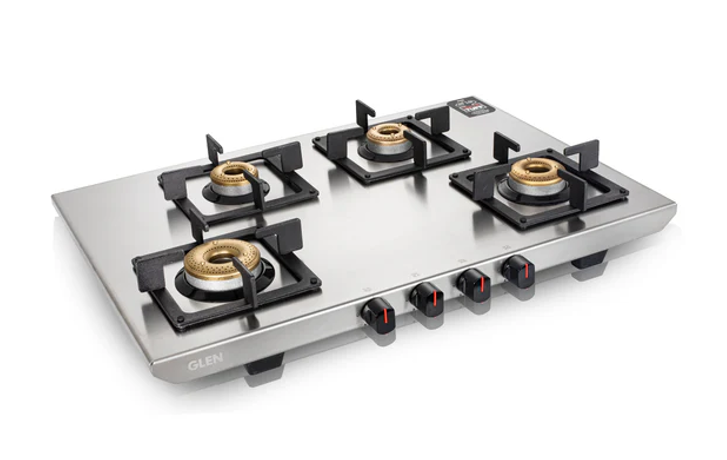
Small Modular Kitchen? Here’s a Practical Way to Pick a Gas Stove Without Losing Counter Space

Indian apartment kitchens have been getting smaller and smaller. The builder ensures more space is allocated to the living area and bedrooms, while the kitchen gets a fixed counter, making mistakes very unlikely. Finding the best gas stove for modular kitchen requires considering several factors, including platform depth, cutout dimensions, and burner spacing, well before deciding on a brand or price range. A gas stove meant for a regular large kitchen will take up at least half of the modular counter unnoticed until it’s installed. Here’s what actually matters when the counter itself is the constraint.
Why Modular Kitchens Change the Stove-Buying Math
Older kitchens gave a stove room to breathe. Wide gaps between burners, deep platforms, counter space on either side, none of that had to be planned around. Modular kitchens flip that arrangement. Cabinet widths get fixed at the design stage. Platform depth rarely goes past 24 to 26 inches. Sinks, hobs, and prep zones all compete for the same narrow strip of counter.
Homeowners working with modular layouts usually run into a familiar set of problems:
- Platform depths are capped at around 24 to 26 inches
- Cooking zones that double as chopping and prep space
- Cabinet space below the counter is shared between the stove’s footprint and the LPG cylinder
- Cabinet finishes and hardware that a bulky or mismatched stove can throw off visually
A tape measure matters more than a spec sheet at the start of this process.
Step 1: Measure the Platform First
Before opening a single shopping app, measure the cooktop platform’s width and depth. Most modular kitchens are built around a fixed cutout, and a stove even a few centimetres too large can knock the whole counter alignment out of place during fitting.
Rough numbers worth keeping handy:
- 2-burner stoves need roughly 20 to 24 inches of width
- 3-burner stoves usually run 24 to 28 inches
- 4-burner stoves often need 28 to 30 inches, sometimes more
The biggest reason installations are postponed by one or two weeks is getting this figure wrong.
Step 2: Matching the Number of Burners to the Usage of the Kitchen
Just because more burners mean more does not necessarily mean more in the case of kitchen usage. An unused burner in a small kitchen is a waste of counter space.
- 2-burner stoves suit single occupants or couples who cook light, quick meals most days
- 3-burner stoves work for small families juggling two or three dishes at a time
- 4-burner stoves only make sense when the platform has the depth and ventilation clearance to support them properly
Buying based on how often the household actually cooks tends to work out better than buying based on what looks like a good deal on paper. This is one of the clearer signs of a genuinely best gas stove for modular kitchen choice versus one that gets half-used and just sits in the way.
Step 3: Look for a Slim, Space-Conscious Build
Several manufacturers now build slimmer stove bodies specifically for compact kitchens. These cut the front-to-back depth without shrinking burner spacing to the point where a large kadai won’t sit safely.
Worth checking before buying:
- Slim glass or stainless-steel bodies with reduced depth
- Burners are set close but still spaced enough for safe heat distribution
- Pans support that fold flat or sit low, so nothing juts past the counter edge
- Control knobs are placed so they don’t add extra width to the unit
A slimmer body doesn’t mean weaker cooking performance. It just removes bulk that has no reason to sit on a counter this size.
Step 4: Consider Built-In or Drop-In Models for Very Tight Layouts
In kitchens where every centimetre counts, a drop-in or built-in stove is worth a real look. These sit flush with the counter surface, cutting the visual clutter of a standalone unit and freeing up a bit of extra edge space.
A few practical perks that come with built-in models:
- A finish that blends into the cabinetry rather than standing apart from it
- Fewer spill zones since the unit sits level with the counter instead of raised above it
- Fewer gaps and edges, which makes wiping down after cooking noticeably quicker
Galley-style and L-shaped modular kitchens benefit the most from this setup, since there’s rarely a spare inch of counter to work with.
See also: 5 Crucial Rules for Betting on 2026 World Cup Extra Time and Penalties
Step 5: Pay Attention to Burner Type and Body Material
Material affects more than looks. It changes how much visual space a stove seems to take up, too. Glass-top stoves generally read as sleeker against modern cabinetry, while stainless steel tends to hold up better through years of daily cooking and heavy pots.
A few things worth checking before buying:
- Brass burners usually deliver better heat efficiency and last longer than other alloys
- Auto-ignition removes the need for a separate lighter, cluttering the counter
- ISI certification confirms the stove meets the safety standards required for LPG use in Indian homes
Step 6: Don’t Neglect Ventilation and Cylinder Positioning
Even a compact-design stove requires proper ventilation and an appropriate cylinder position. When you plan to buy gas stove sets for your modular kitchen, be sure you have figured out where the cylinder will be placed, because that cabinet space usually houses cookware or detergents.
A few safety checks worth running through:
- Keep the cylinder in a ventilated cabinet that’s easy to reach
- Avoid placing it directly under the stove without a gap
- Leave enough slack in the regulator and pipe so nothing gets forced into an awkward coil
Conclusion
When selecting a gas stove for a small modular kitchen, it is important to balance the user’s actual cooking behavior with the available counter space. When the counter is measured, the number of burners is selected based on usage, with a focus on more compact models. Anyone looking to buy gas stove models built for tighter Indian kitchens will find that Glen Appliances makes a range of space-efficient designs suited to modular layouts. Glen Appliances also builds these stoves with proper safety certification, giving compact kitchens a stove that fits without giving up cooking performance.