Context Windows Are Not All 1M Tokens: What a 205K Model Still Gets Right

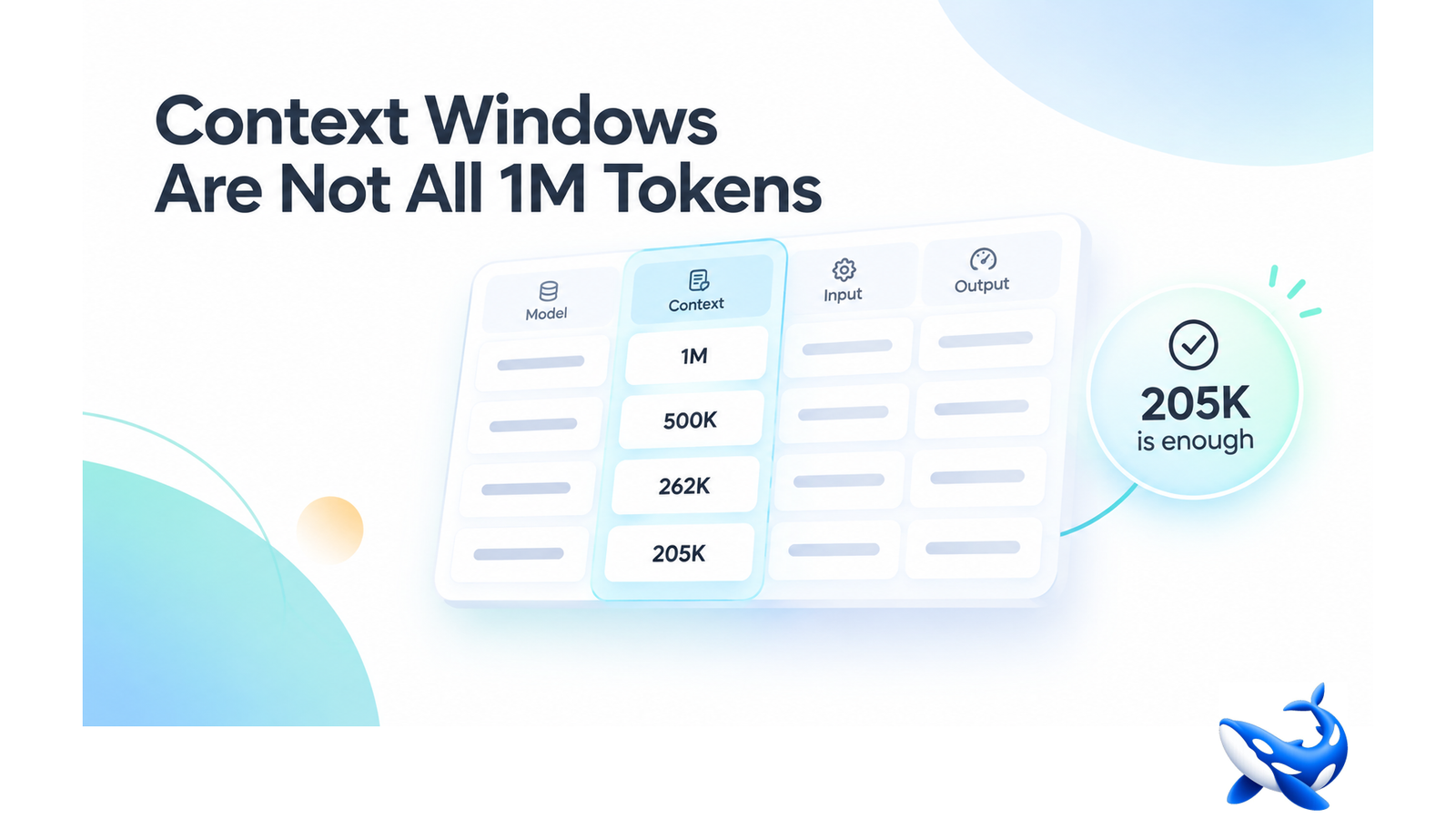
Scan the context column of an OrcaRouter llm comparison table and the numbers look as if they were pasted in from different product generations: eight of the twelve models carry a one-million-token window, one sits at five hundred thousand, another at two hundred sixty-two thousand, a fourth at two hundred five thousand, and the most expensive row of all does not publish a context number at all.
The smallest window on the page can still be the right pick for a real workload, and treating the context column as one uniform spec is the fastest way to misread the whole table.
The column that looks uniform
The twelve rows in our comparison table read as if they describe a single feature, but the range between them is enormous. Eight models — Claude Fable 5.1, Claude Opus 5.5, Claude Sonnet 5.5, DeepSeek V4 Pro, Gemini 3.1 Pro Preview, Gemini 3.8 Flash, GPT-5.4, and GPT-6 Sol — all list a one-million-token context window. Then the pattern breaks. Grok 4.7 stops at five hundred thousand tokens, kimi-k2.6 at two hundred sixty-two thousand, and MiniMax M2.7 highspeed at two hundred five thousand. The last row, GPT-5.5 Pro, is the most expensive model in the table at $30 per million input tokens and $180 per million output, and it does not publish a context number at all.
A context window is not a technical constant that a vendor reports the way they report a price. It is a design decision, and the decision varies with positioning. A flagship priced at a premium advertises the largest window it can honestly claim, while a budget card often settles for a smaller one to keep cost per request down. The result is a column that mixes flagships, workhorses, and one deliberate silence, and reading it as uniform hides exactly the information the page exists to show.
Look at the pattern from the vendor side and the table starts to make sense. The three Anthropic rows — Claude Fable 5.1 at $10 input and $50 output, Claude Opus 5.5 at $4 and $20, Claude Sonnet 5.5 at $2 and $10 — all carry the one-million-token window because that is the house standard for the line. Google does the same across Gemini 3.1 Pro Preview at $2 and $12 and Gemini 3.8 Flash at $0.75 and $3.75. Then the smaller players split: DeepSeek V4 Pro at $0.66 and $1.98 keeps the full million, while kimi-k2.6 at $0.95 and $4.00 stops at two hundred sixty-two thousand and MiniMax M2.7 highspeed at $0.60 and $2.40 stops at two hundred five thousand. Same column, three different answers, and not one of them is a mistake.
See also: Real-Life Applications of Artificial Intelligence
What each window is actually for
The smallest number belongs to MiniMax M2.7 highspeed, a model that costs $0.60 per million input tokens and $2.40 per million output — the cheapest card in the whole table — and reaches its first token at a 3.29-second p50. Two hundred five thousand tokens is not a small budget. It holds roughly the length of an entire technical book, a multi-hour meeting transcript, or a full codebase directory with its documentation, all in a single turn. For the workloads that dominate production traffic, that is more headroom than most requests will ever touch.
kimi-k2.6 sits one step up at two hundred sixty-two thousand tokens for $0.95 per million input and $4.00 per million output, with a 5.84-second p50 on first token. Grok 4.7 goes further, to five hundred thousand tokens, at $2.00 per million input and $6.00 per million output, with a 3.63-second p50. Each step up buys a bigger envelope, and each step also costs more — but not proportionally, and not for every kind of work. Doubling the window from two hundred five thousand to five hundred thousand tokens roughly doubles the price of Grok 4.7 against MiniMax M2.7 highspeed at the input side, and triples it at the output side, while the middle rung — kimi-k2.6 — sits almost exactly halfway between them on both price and window. The ladder is real, but it is not a straight line, and the bends are where the interesting choices live.
When the smallest number wins
Here is the part that surprises people who only skim the table: most real workloads never come close to their context ceiling. A typical turn might carry a few thousand tokens of instructions and a handful of documents. A 205K window is not a compromise for that workload — it is more than enough, delivered by a model that is also the cheapest row on the page. The smallest number is the right pick whenever your payload fits comfortably inside it, which is most of the time.
The large window matters in the opposite direction. If you routinely feed a model an entire release history, a full legal docket, or a year of support tickets in one call, you are one of the few workloads that genuinely needs the million-token tier. And there is a cheap route there too: DeepSeek V4 Pro offers a one-million-token window at $0.66 per million input and $1.98 per million output, so a big envelope does not have to come with a flagship price. The point of reading the column correctly is knowing which side of that divide you are on.
The row that refuses to say
GPT-5.5 Pro deserves its own paragraph, because its context cell is empty. The row costs $30 per million input tokens and $180 per million output, the dearest in the table, and its context window is not published. That is unusual enough to be information in itself. When a vendor chooses silence over a number, it is usually because the number would invite a comparison they would rather not invite. Whatever the reason, an empty cell is a reminder that every other cell in that column is a choice, not a law of physics.
Reading the column correctly
The practical rule is short. First, measure your own payload distribution before you trust any context figure — run a day of real requests and look at the largest token count per call. Second, pick the window that fits that distribution with margin, not the largest one on sale. Third, if you do need the million-token tier, price-shop it the way you would price-shop any other spec, because the column shows you can get a million tokens of window at one of the cheapest rate cards in the table.
The takeaway
Context windows in a modern comparison table are anything but uniform. Eight models claim a million tokens, three deliberately stop at five hundred thousand, two hundred sixty-two thousand, or two hundred five thousand, and one flagship says nothing at all. The number only becomes useful when you hold it against your own traffic, and when you do, the smallest figure on the page can turn out to be the right pick for most of what you run.
Do not filter a shortlist on context size first. Shortlist on price and latency for the work you actually do, then check whether your real payloads fit the window. The table will happily sell you a million tokens you will never use; the smarter buy is the window your data actually fills. And when two finalists land on the same rate card, let the column decide the tie — the cheaper-sounding row is often the one with the smaller envelope, and that trade only pays off when your longest request still lands inside it.
Sourcing note: all twelve models, prices, context windows and p50 time-to-first-token figures are from the OrcaRouter comparison page and the linked model page, read 2026-10-12. The p50 figures are rolling production telemetry and will drift; the 10.00 s value that appears for some rows is the measurement ceiling, not a real latency. All checked 2026-10-12.